Codex CLI now has a HookBus publisher
Codex is now part of the HookBus publisher family. The new Codex CLI publisher forwards agent lifecycle events into HookBus so audit, policy, budget, AgentFlow, and observability subscribers can see what the agent is doing at runtime.
AI agents are becoming normal developer infrastructure. They read prompts, choose tools, run commands, write files, and produce outcomes. That means the governance problem is moving from policy documents into the runtime.
HookBus exists for that runtime layer. It gives agent runtimes a shared event path: publishers emit lifecycle events, the bus fans them out, and subscribers provide audit, policy, spend, approval, and AgentFlow behaviour.
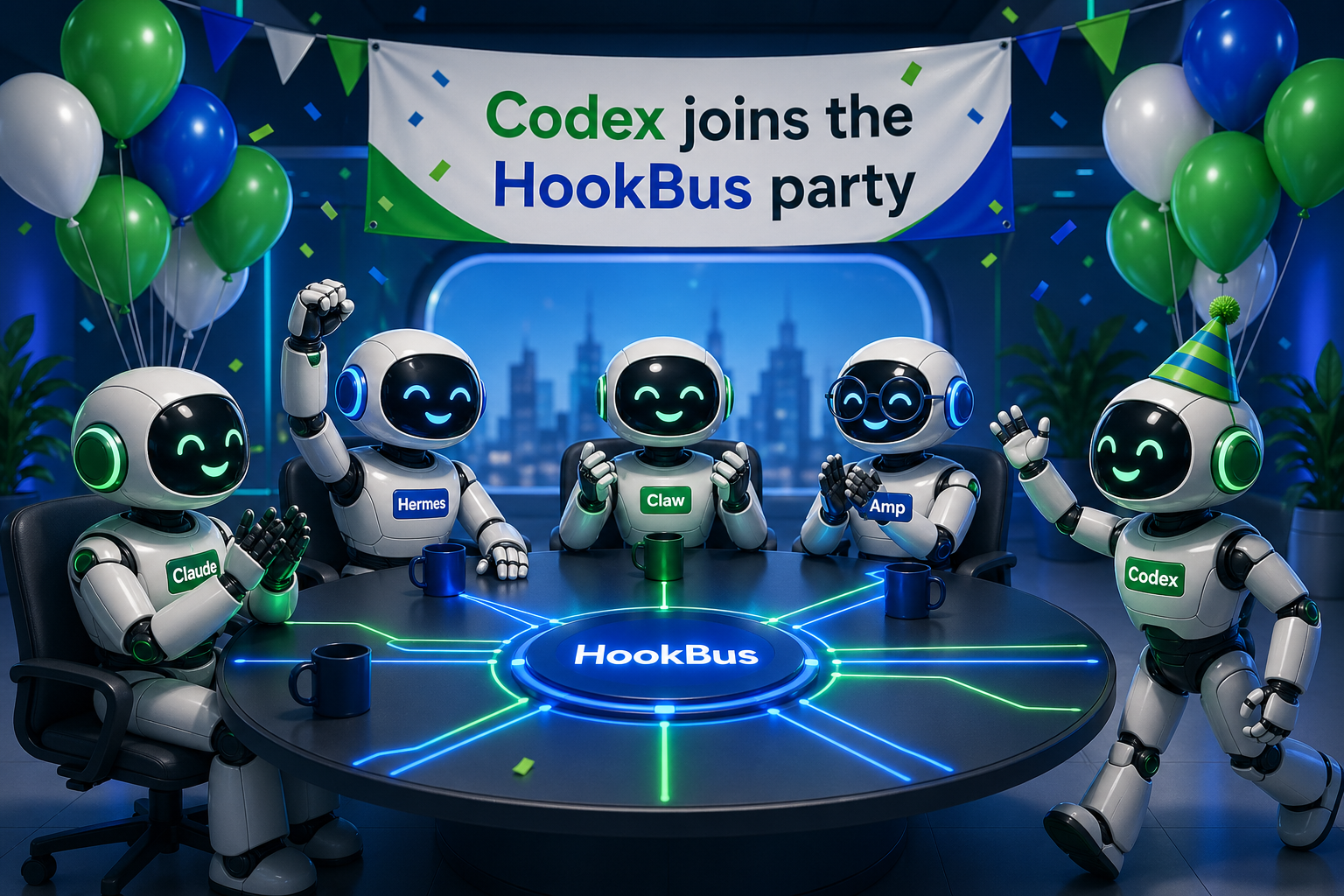
Today, Codex CLI joins the live publisher set alongside Claude Code, Hermes, OpenClaw, and Amp.
What the Codex publisher does
The Codex publisher installs a lightweight local gate, codex-gate, and registers Codex hook handlers. When Codex emits lifecycle events, the publisher turns them into HookBus-compatible envelopes and posts them to the configured bus.
The current publisher covers the practical lifecycle surface exposed by Codex today:
SessionStartwhen a session starts or resumes.UserPromptSubmitwhen a user submits a prompt.PreToolUsebefore supported tool execution.PostToolUseafter supported tool execution.Stop, mapped into a model-response evidence event where the hook surface exposes useful output.
The publisher also ships a verification command:
codex-gate --doctorThat doctor command checks the installed gate, Codex hook files, and HookBus event path. It also catches the issue that most often makes a hook install look broken: an already-running CLI session has not reloaded the hook configuration yet.
Why this matters
Runtime governance only works if agent events reach the governance layer. If a tool call happens outside the bus, there is no subscriber decision, no audit trace, and no common evidence trail for the organisation to review later.
For regulated teams, the useful question is no longer just "does the agent have a safety prompt?" It is:
Can the runtime show what the agent was asked, what it attempted, what was allowed or blocked, and which control made the decision?
HookBus turns that into infrastructure. Codex CLI now has a publisher path into that infrastructure.
Built against the AgentHook direction
The Codex publisher is also part of the wider AgentHook work: a draft open standard for AI-agent runtime evidence. AgentHook defines the common lifecycle vocabulary. HookBus is a reference bus. Publishers are the adapter layer that gets today's real tools speaking that language while native support matures.
This is deliberately boring infrastructure. That is the point. Agent teams should not have to invent a new audit path for every runtime. They should be able to install a publisher, point it at a bus, and see events.
Try it with HookBus Light. Install HookBus Light, install the Codex publisher, run codex-gate --doctor, then open the dashboard and watch the events arrive.
Install the Codex publisher View on GitHub
If you are evaluating runtime governance for agentic AI, book a pilot discussion.
← All posts